
Estimate
TWD 11,000,000-19,000,000
HKD 2,716,000-4,691,000
USD 347,000-599,400
CNY 2,316,000-4,000,000
Sold Price
Signature
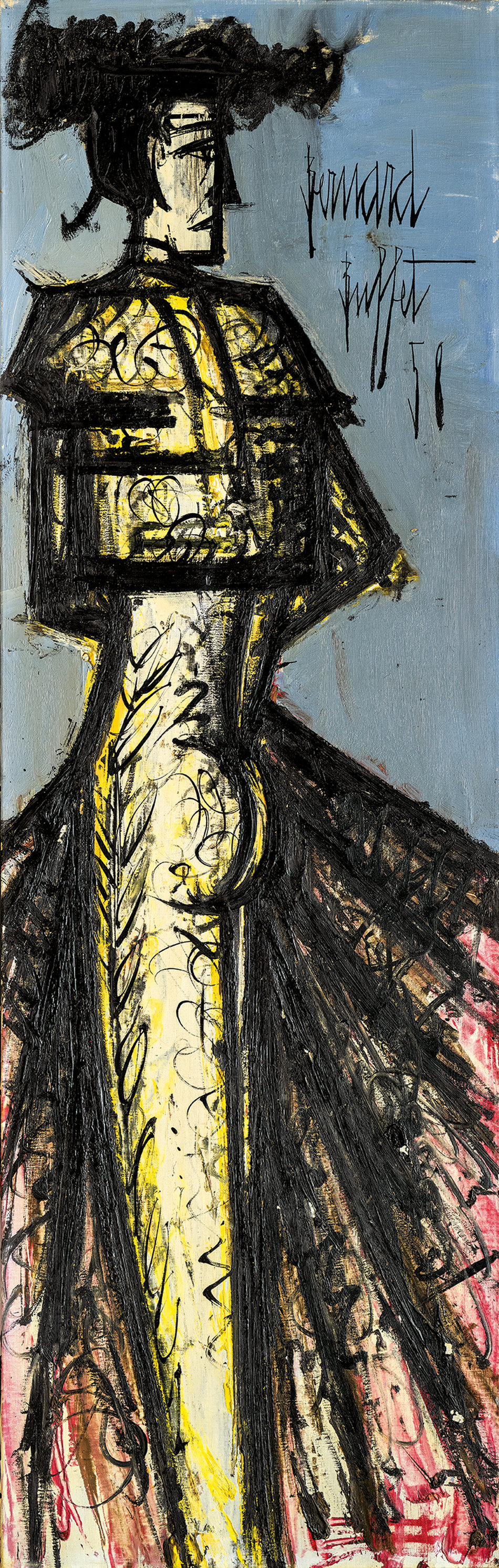
Signed upper right Bernard Buffet and dated 1958
Bearing a David et Garnier Gallery stamp and inscribed V72 on the reverse
PROVENANCE
Ader-Picard-Tajan, Paris, November 18, 1989, lot
130
Private collection, Asia
Bearing a David et Garnier Gallery stamp and inscribed V72 on the reverse
PROVENANCE
Ader-Picard-Tajan, Paris, November 18, 1989, lot
130
Private collection, Asia
This lot is accompanied by a certificate of authenticity issued by Galerie Maurice Garnier,
Paris.
Paris.
+ OVERVIEW
French artist Bernard Buffet (1928–1999) was one of the foremost figures in postwar French figurative painting. Born in Paris, he entered the École Nationale Supérieure des Beaux-Arts at the age of fifteen, demonstrating exceptional artistic talent from an early age. In 1948, Buffet was awarded the Prix de la Critique, swiftly establishing himself within the postwar French art scene. Within a decade, he had risen to international prominence. His bold and distinctive pictorial language not only defined his individual artistic identity, but also secured his place as one of the most recognisable representatives of postwar French figurative art.
The year 1958 marked a significant milestone in Buffet’s career. He was commissioned by Time magazine to create the cover portrait for its annual Man of the Year feature, depicting Charles André Joseph Marie de Gaulle, the
first President of France’s Fifth Republic. In the same year, Buffet collaborated with celebrated French novelist Françoise Sagan on the programme and costume designs for Le Rendez-Vous, a ballet by their mutual friend Albert
Sarfati. Galerie Charpentier in Paris also presented his
first major retrospective, Cent tableaux, de 1944 à 1958(One Hundred Paintings, 1944–1958). The exhibition opening was reportedly attended by approximately 8,000 people, while the total number of ticketed visitors reached 100,000. These extraordinary figures attest not only to Buffet’s magnetic appeal, which had captivated audiences across Europe and the United States in the postwar years, but also to his profound influence on the broader cultural imagination. Executed in 1958, Toréador à la muleta (Matador with
Red Cape) is a quintessential work of this period. Its imposing vertical format, measuring 160 centimetres in height, lends the figure an almost monumental
stature. Heavy, incisive black strokes define the matador’s commanding silhouette, while interwoven accents of yellow, white, and pink stand out against
a cool blue-grey ground, generating striking visual tension. By eliminating the clamour of the bullring, Buffet directs the viewer’s attention entirely towards
the matador himself. In the artist’s austere and restrained manner, blade-sharp black lines project from the surface like sculptural relief, articulating the ornate headgear, embroidered traje de luces, and taut contours of the body. The matador’s profile is composed and resolute, his gaze concealed in
shadow. Here, outward bearing and inner fortitude become inseparable, embodying the distinctive Buffet aesthetic—restrained yet forceful, and unmistakably his own. Buffet’s Toréador series reveals the maturity of an artistic language in which his personal aesthetic is fused with dramatic subject matter. Approaching the bullfighting ritual through a compositional sensibility reminiscent of classical history painting, Buffet reinterprets the spectacle as an event of solemnity and spiritual intensity, once describing its beauty as possessing an almost religious quality. Within Spanish culture, bullfighting is more than a contest of strength and skill; it is imbued with courage, honour, ritual, and an unflinching confrontation with death. In Buffet’s vision, the arena becomes a stage upon which the tension of life, the awareness of destiny, and the drama of a fleeting moment converge.From an art-historical perspective, Buffet’s interpretation of bullfighting offers a compelling counterpoint to the Spanish artistic tradition. While Francisco Goya (1746–1828) explored the darker dimensions of fate and human nature, and Pablo Picasso (1881–1973) pursued an exuberant and experimental exploration of form, Buffet focused
on the distillation of gesture, the expressive force of contour, and the dramatic tension of a moment poised between stillness and action. Through his precise and emphatic forms, he transforms fleeting movements into enduring visual images.
Related Info
Modern & Contemporary Art
Ravenel Autumn Auction 2026 Taipei
Sunday, December 6, 2026, 1:30pm