
Estimate
TWD 40,000-80,000
HKD 10,000-20,000
USD 1,300-2,500
CNY 9,000-17,000
Sold Price
TWD 168,000
HKD 41,687
USD 5,325
CNY 36,207
Signature
With one seal of the artist
PROVENANCE
Private collection, Taiwan
+ OVERVIEW
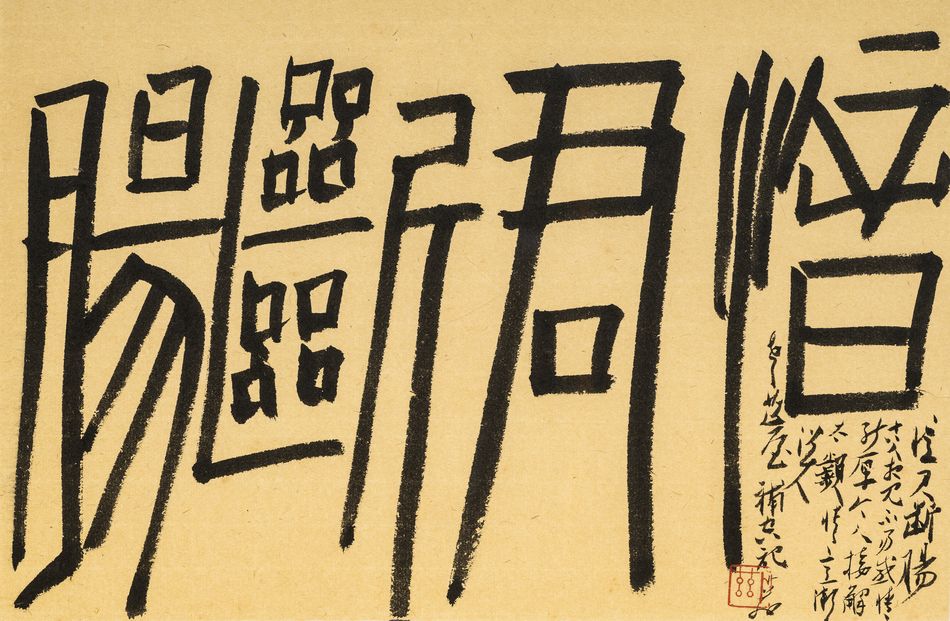
The brushwork of this work evokes the tactile qualities of seal carving, particularly the chisel marks and fractured edges characteristic of carved stone. In the four characters yi-jun-duan-chang, the vertical strokes descend with weight and gravity, recalling the resistance encountered when a blade cuts into stone. Each script in Chinese calligraphy possesses its own expressive character and appropriate function. Seal script, in general, is not considered well suited to the direct expression of emotion. Here, however, the tightly compressed arrangement of the four characters leaves little room for visual release, subtly conveying within a confined space the tension and anguish of longing. Another particularly ingenious feature appears in the character yi (憶). When first writing the character, PU Tzu deliberately left the “heart” radical unfinished. He later filled the blank part by a poem of his own composition; that is to say, he completed the character by adding back “the heart”, which carries his messages. Since the heart signifies the seat of emotion, this gesture reveals the artist’s conscious sense of design within the act of writing.
Epigraphic studies restored and flourished during the Qianlong and Jiaqing periods of the Qing dynasty, focusing on the study of steles, bronzes, and ancient seals. This movement shifted the direction of calligraphy from the modelbook tradition (tie) toward the study of inscriptions (bei), profoundly transforming the aesthetic orientation of modern calligraphy. Seal script thus came to be valued not merely as an archaic form of writing, but as a means of reconnecting with early cultural origins. Beyond his celebrated wild cursive works, PU Tzu maintained a deep interest in epigraphy, believing that the true essence of calligraphic beauty lies in the bronze and stone inscriptions of the Three Dynasties. In the present work, PU Tzu seems to refine emotion into a molten substance and cast into the archaic structure of seal script. It may be said that the work takes ancient epigraphic tradition as its form while employing modern personal expression as its spirit.
Refined Brushwork:Ink Paintings & Works of Art
Ravenel Spring Auction 2026 Taipei
Sunday, May 24, 2026, 4:00pm